Infoblox-white logo

Next-level networking experiences, delivered today.

Infoblox, with more than 8000 customers including 350 of the Fortune 500, provides advanced core networking and security services—informed by user network context—to enable next-level networking experiences for IT teams and users everywhere. Our BloxOne™ Platform has also set the foundation for a modern, cloud-native management architecture that accelerates, automates and secures today’s modern workforce.

The power of cloud-first agility

For cloud-first organizations, Infoblox eliminates siloed confusion and manual errors as your network scales, while also protecting users and devices everywhere. Our BloxOne® DDI unifies DNS, DHCP and IPAM (DDI) services to give you greater visibility and automation across your hybrid, multi-cloud enterprise. And BloxOne Threat Defense slashes detection and remediation time for cyberattacks using real-time DDI data.

Simplify your journey to a SaaS-enabled enterprise

Control

Deliver DNS, DHCP, IPAM and security with multi-cloud visibility and control

Automation

Leverage best-in-class integrations and APIs to make NetOps, DevOps and SecOps frictionless

Security

Use DNS-layer protection to accelerate cyberthreat detection and response

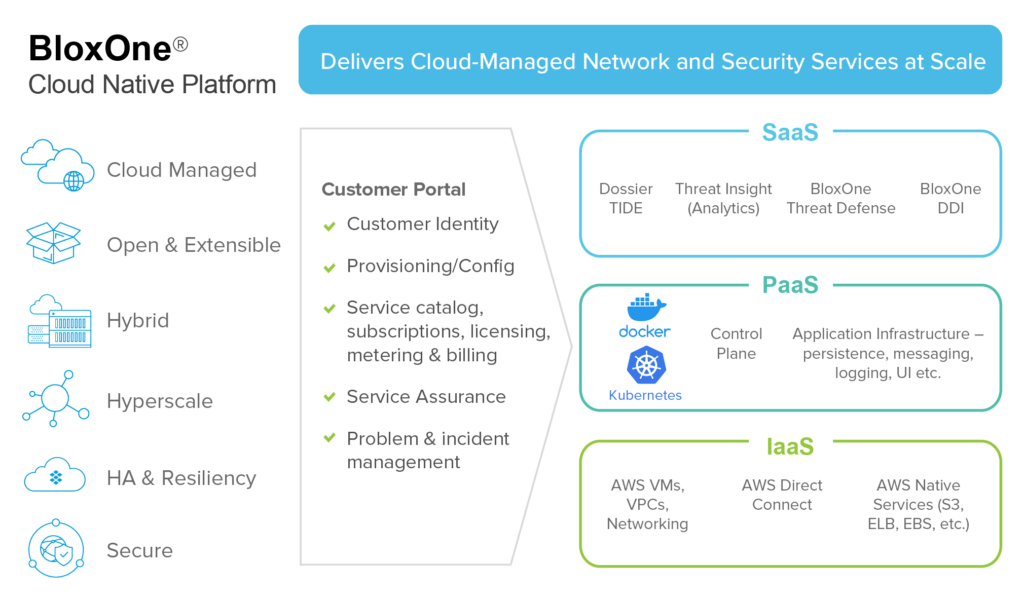
Meet the BloxOne Platform

Our advanced cloud-native architecture combines networking and security as a service to help you centrally manage multi-cloud workforce transformation at any scale.


Single-pane-of-glass view for every device and user.

Worry-free network experiences that just work.

Streamlines and simplifies DevOps, NetOps and SecOps

Deliver total network reliability across remote users and sites 

Accelerated threat detection and remediation

Elastic and flexible — Only use what you need as you grow

Opportunity and Challenges

Even as organizations cope with the immediate priorities presented by the COVID-19 pandemic, they need to also consider
the longer-term business imperatives driving modernization. Fostering an agile business that can scale out simplicity
while mitigating security risk will require decision makers to have an effective strategy for deploying three key technology
paradigms, each of which presents challenges to overcome.

icon1

Migration to Cloud
 

To emulate the cloud-first model, and realize the business value it offers, organizations will need to significantly increase their use of cloud/SaaS applications.

Providing direct access to cloud applications from everywhere results in a shifting perimeter. If not executed correctly, application performance suffers, and security threats proliferate.

icon2

Software Defined Networking (SD-WAN)

Adopting SD-WAN promises to improve user experiences at branch and remote locations by enabling geolocal responses to applications and servers.


Local Internet breakouts leave SDWAN branches exposed to malware attacks and data breaches that can compromise the entire organization. Equipping SD-WAN branches with a full security stack, however, can be cost prohibitive.

icon3

Internet of Things, BYOD
 

Device proliferation is an unstoppable wave. The IoT is playing a central role in transforming multiple industries, from transportation to retail. Meanwhile, BYOD is a simple fact of life for today’s corporate workforces.

Endpoint security cannot be deployed on lightweight IoT devices, leaving them exposed to exploitation. Similarly, if you don’t have clear visibility into devices logging onto your network, the security implications can be dire.

Inquire Now